
ReadyAPI and Rentgen are often mentioned together when teams compare API testing tools, but they operate in very different parts of the workflow. Treating them as competitors misses the point. They solve different problems, at different stages, for different audiences.
ReadyAPI is part of a long lineage that started with SoapUI, one of the oldest and most widely used API testing tools in the industry. Over the years it evolved into a full enterprise platform for functional testing, security testing, performance testing, and automation. Many teams still rely on it for complex, regulated environments where structured testing is not optional.
Rentgen is not trying to enter that space. It exists earlier, before structured testing even begins, when a developer has a working endpoint and wants to understand how fragile it is under imperfect input.
ReadyAPI is built for long-term, structured testing
ReadyAPI is designed for teams that need control, repeatability, and depth. You define test cases, create assertions, build workflows, simulate environments, run performance tests, and integrate everything into CI/CD pipelines. It is not just about sending requests. It is about proving that an API behaves correctly under well-defined conditions.
This kind of testing matters in enterprise systems, especially in finance, healthcare, telecom, or any regulated domain where behavior must be predictable and auditable. ReadyAPI allows teams to build large, maintainable test suites that run continuously and enforce quality gates.
But this level of structure comes with a cost. Someone has to design the tests, define the assertions, maintain the suites, and update them as the system evolves. The tool does not guess what to test. It executes what you define.
Rentgen is built for what you have not defined yet
Rentgen starts from a different assumption: before you invest time building structured tests, you should understand how the API behaves when input is not perfect. Not because you expect failure, but because real systems inevitably receive messy data.
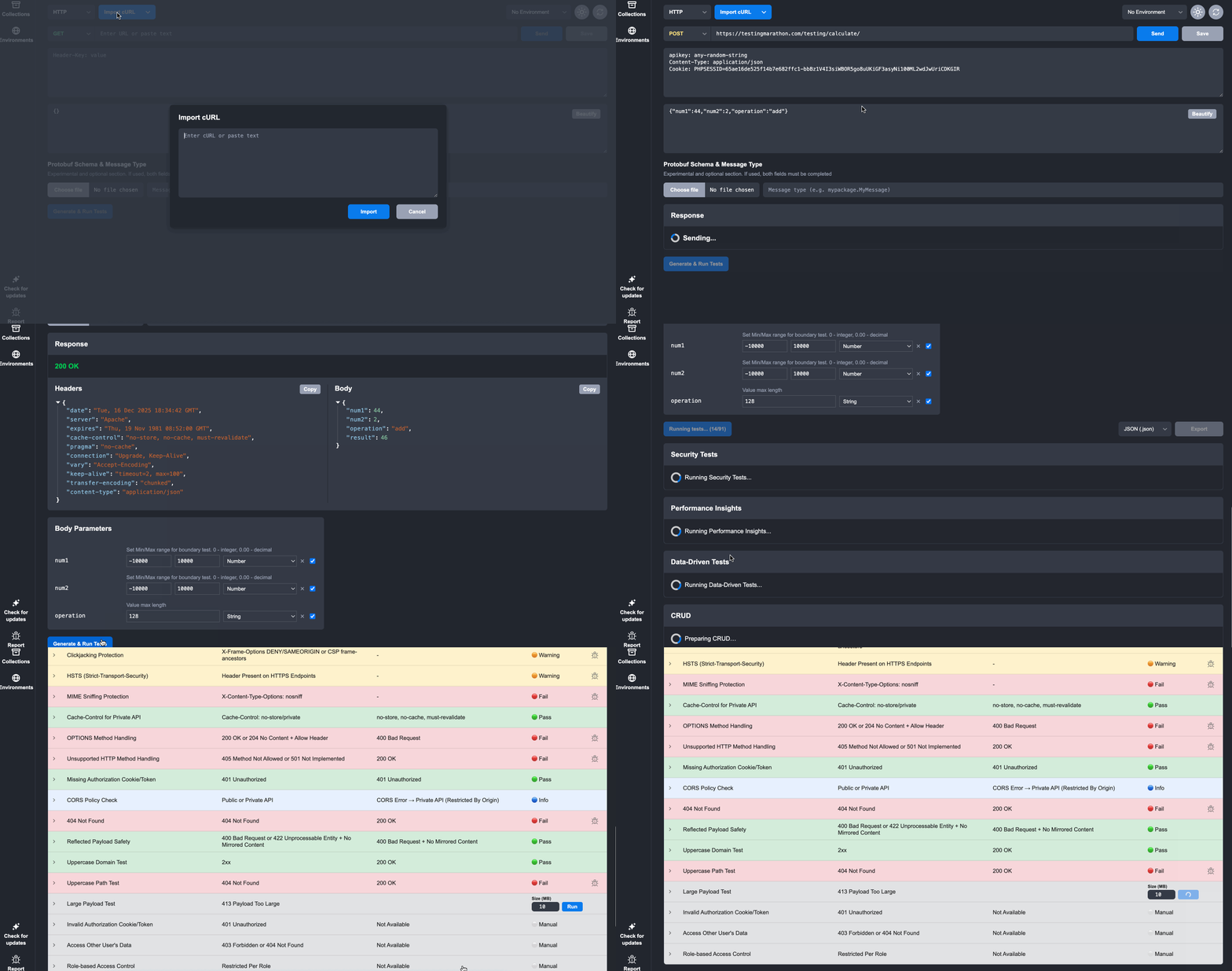
Instead of asking you to define test cases, Rentgen takes a single working cURL request and generates variations automatically. Missing fields, wrong data types, boundary values, whitespace issues, malformed payloads, and other edge cases are explored without writing a single assertion.
The goal is not to prove correctness. The goal is to expose behavior. Does the API return consistent 4xx responses? Does it leak 500 errors? Does validation behave predictably? Are responses clear enough for clients to understand what went wrong?
The difference is not power. The difference is timing.
ReadyAPI is powerful because it allows teams to define exactly what “correct” means and enforce it over time. Rentgen is useful because it shows what happens before that definition even exists.
If you skip that early exploration, you risk building large automated test suites around assumptions that were never challenged. The tests pass, but only because they never looked at the messy cases that eventually appear in production.
Rentgen reduces that risk by providing a quick, local check of how the API behaves under imperfect input. It does not replace structured testing. It improves the starting point for it.
A workflow that uses both
A practical workflow is sequential. A developer builds or changes an endpoint and verifies it with a simple request. Then that request is passed through Rentgen to uncover obvious weaknesses. Missing validation, inconsistent responses, or unexpected errors can be fixed immediately.
After that, ReadyAPI comes into play. The team defines proper test cases, builds automation, integrates with CI/CD, and ensures that behavior stays consistent over time. At this stage, structured testing makes sense because it is based on observed behavior, not assumptions.
No need to compare them as alternatives
ReadyAPI is one of the most mature API testing platforms available. It has a clear role in enterprise environments and continues to be relevant because structured testing is still necessary.
Rentgen is a smaller, more focused tool that solves a different problem. It helps developers and QA engineers quickly see how an API behaves when the input is not ideal, before committing to formal testing strategies.
They do not compete. They complement each other.
ReadyAPI helps you prove your API behaves correctly under defined conditions. Rentgen helps you discover how it behaves when conditions are not defined yet. Same API, different stage, different responsibility.