
ffuf and Rentgen sometimes end up in the same conversation because both touch fuzzing, HTTP, and things that break when input changes. But this is one of those comparisons that sounds reasonable only until you actually look at the job each tool is doing.
ffuf is a fast web fuzzer. It is excellent for content discovery, virtual host discovery, parameter fuzzing, wordlist-based attacks, hidden paths, strange endpoints, and all the classic web enumeration work that security testers and bug bounty people understand very well. It is a sharp command-line tool for finding what exists, what responds, and what behaves differently when you throw large sets of inputs at a target.
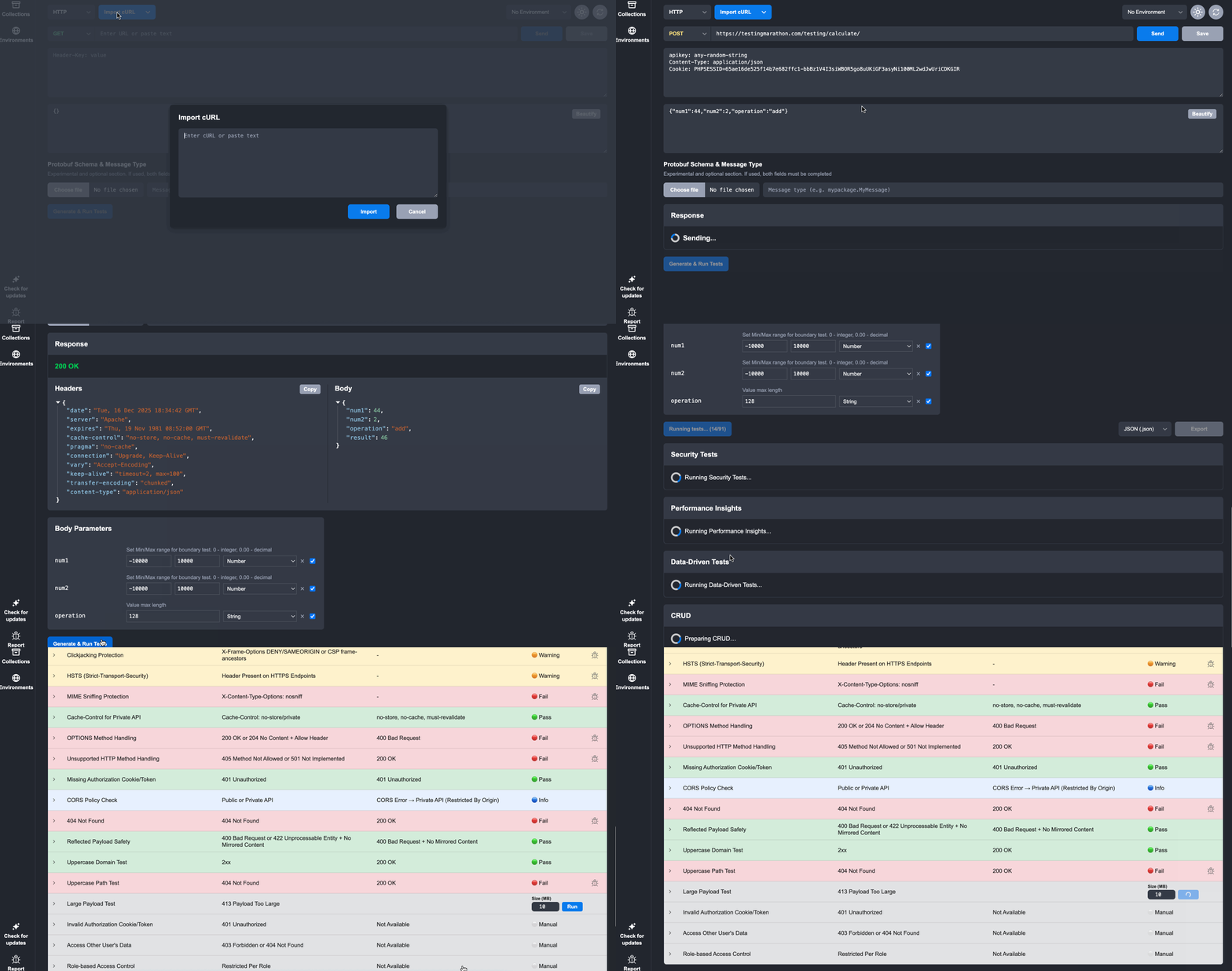
Rentgen is not trying to do that. Rentgen is built for a different moment: you already have one working API request, usually copied as cURL, and you want to know how that specific endpoint behaves when the input stops being perfect.
ffuf is a serious web fuzzing tool
ffuf makes sense when you want to discover things. Directories, files, virtual hosts, parameter names, parameter values, hidden resources, unexpected responses. You give it a wordlist, define where the FUZZ keyword goes, apply matchers and filters, and let it run.
That workflow is extremely useful in security testing. If you are looking for hidden paths, forgotten admin panels, unusual host headers, valid parameters, or responses that differ from the baseline, ffuf is exactly the kind of tool you want. It is fast, flexible, scriptable, and very comfortable for people who live in terminals.
It also gives a lot of control. You choose the wordlist, filters, matchers, request shape, rate, recursion, payload source, and even external mutators like Radamsa if you want more aggressive payload generation. This is proper fuzzing territory.
Rentgen does not start from a wordlist
Rentgen starts from a different assumption. You are not trying to discover hidden URLs. You are not trying to enumerate virtual hosts. You are not trying to brute-force parameter names. You already have a real request that works.
That request might come from a browser, Swagger, Postman, Insomnia, HTTPie, logs, or an API client. Rentgen takes it and expands the body, headers, method behavior, values, boundaries, authentication cases, and malformed input scenarios around that request.
The question is not “what exists here?” The question is “how does this endpoint behave when this known request becomes messy?”
Different problem, different user, different signal
ffuf is brilliant when you need discovery. It helps you find paths, parameters, hosts, and response differences. The signal is usually about what responds, what stands out, and what should be investigated further.
Rentgen is built for API behavior. It checks how one endpoint handles missing fields, wrong types, invalid enums, whitespace, oversized values, malformed payloads, unsupported methods, and status-code consistency. The signal is about whether the backend handles bad input safely and predictably.
These are not the same signals. A hidden endpoint found by ffuf is one kind of finding. A known endpoint returning 500 because a required JSON field is missing is another. Both matter, but they belong to different parts of the testing conversation.
ffuf requires you to define the fuzzing strategy
With ffuf, you are in control of the fuzzing position. You decide where FUZZ goes. In the URL, in the Host header, in a query parameter, in POST data, or through an external input command. That flexibility is the power of ffuf.
But it also means the tester needs to know what they are trying to fuzz. You need a wordlist, a target shape, filters, matchers, and some understanding of what a useful difference looks like. For security testers, this is normal. For a backend developer who just finished an endpoint and wants a quick API hygiene check, it may be more setup than they want at that moment.
Rentgen intentionally lowers that entry barrier. Paste one working cURL, generate tests, run them, and inspect the behavior. No wordlists. No FUZZ markers. No filter tuning. No need to decide manually which field should be broken first.
Rentgen is not a replacement for ffuf
If you want to discover hidden directories, fuzz virtual hosts, brute-force parameters, or run wordlist-based web enumeration, Rentgen is not the right tool. That is ffuf territory, and ffuf is very good at it.
If you want to take a known API request and quickly understand how the backend handles imperfect input, Rentgen is the better fit. That is not because it is “better than ffuf”. It is because the job is different.
One is a web fuzzer. The other is an API hygiene scanner. Mixing those categories creates a fake comparison.
A workflow where both make sense
In a security-heavy workflow, ffuf might help discover interesting endpoints, parameters, or hosts. Once a real API request is identified and understood, Rentgen can take that request and check how the backend behaves under structured negative input.
That is a useful sequence. ffuf can help find surfaces. Rentgen can help challenge a known API surface. One helps you discover where to look. The other helps you understand how a specific endpoint behaves when it is no longer treated politely.
No competition required
ffuf is a respected, fast, practical tool for web fuzzing. Rentgen is a focused local-first tool for API pre-testing from a single cURL request. They are not fighting for the same job.
Use ffuf when you need discovery and fuzzing control. Use Rentgen when you already have one working API request and want to expose edge cases before QA, automation, or production finds them for you.
ffuf asks: what can I find by fuzzing this target? Rentgen asks: what does this known API request fail to prove? Same HTTP world, different planet, different job.