
Large API responses almost never look like bugs at first. The endpoint works. The JSON is valid. The client receives data. Nothing crashes.
And that’s exactly why oversized responses survive for months — sometimes years — until performance degrades, mobile clients suffer, and nobody remembers how it started.
What was tested
Rentgen observes response sizes during normal test execution.
No special load, no synthetic requests.
If any single JSON response exceeds 100 KB,
the test is marked as failed.
This is intentionally strict. Returning megabyte-sized JSON payloads is almost never a good default — especially for APIs consumed by web or mobile clients.
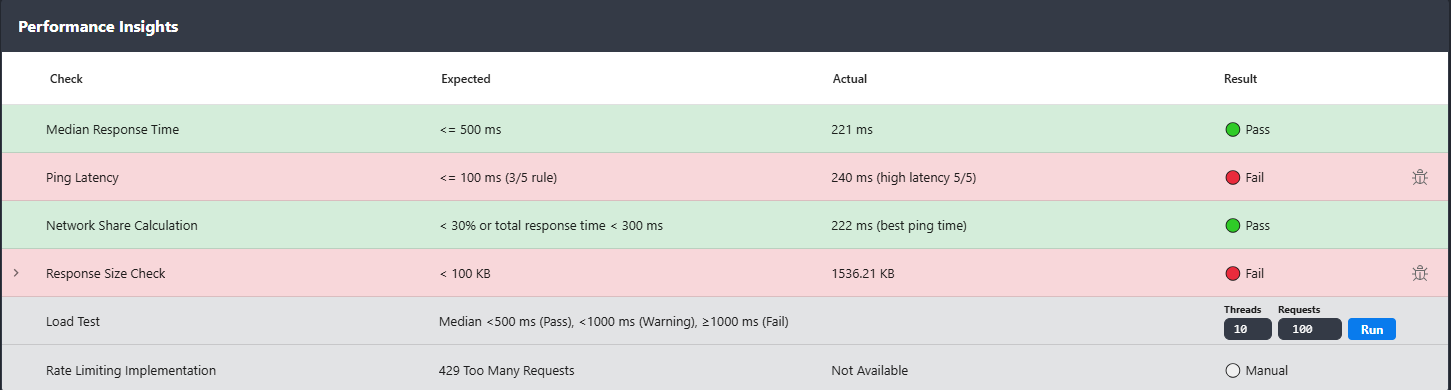
What Rentgen found
- TEST: Response Size Check
- Expected: JSON response size
< 100 KB - Actual:
1536.21 KB - Status: 🔴 Fail
Why this is a real problem
Returning large JSON responses is rarely intentional. It usually indicates poor API design decisions that accumulated quietly: overfetching, missing pagination, missing filtering, or internal data leaking into public responses.
The real damage is not theoretical. Large responses create very real problems:
- slower response times, especially on mobile networks
- high memory usage on clients
- slower JSON parsing and rendering
- increased bandwidth costs
- fragile clients tightly coupled to oversized payloads
Client-side pagination does not solve this. By the time the client paginates, the damage is already done — the data has been transferred, parsed, and allocated in memory.
Why nobody notices this during manual testing
Because manual testing focuses on correctness, not scale. A tester sends a request, sees data, and moves on. A developer checks a response in Postman and thinks: “Looks fine.”
Nobody scrolls through a 1.5 MB JSON payload and thinks: “This will destroy mobile performance in six months.”
By the time it becomes obvious, the response shape is already depended on by clients, making it painful and risky to change.
Why this turns into a future disaster
Oversized responses tend to grow, not shrink. New fields get added. Nested objects expand. “Temporary” debug data becomes permanent.
Eventually teams are forced to optimize under pressure: caching hacks, partial rewrites, breaking changes, or emergency pagination retrofits. All of this could have been avoided by catching the problem early.
How Rentgen helps
Rentgen catches oversized responses automatically, during normal test execution. You don’t need to inspect payloads manually or remember to check sizes.
When the check fails, Rentgen provides a ready-to-copy bug report that explains the impact, shows the measured response size, and suggests concrete design-level fixes. The goal is not blame — the goal is early correction.
What a healthy API does instead
Well-designed APIs return minimal, intentional data by default. Large datasets are handled explicitly through pagination, filtering, and expansion parameters.
If a response “looks big”, it probably is. And if it is big today, it will be worse tomorrow.
Final thoughts
Response size is not a cosmetic metric. It is a design signal.
Rentgen checks it because once oversized payloads reach production, they are expensive to undo. Catching them early saves performance, money, and future arguments.